
Nasu Karasuyama Castle Ruins
Explore the extensive earthworks and stone walls of a strategically vital mountain castle, once the stronghold of the Nasu clan.
Highlights
Must-see attractions

Social
From TikTok & Reddit
Best Time
Fewer crowds, peaceful exploration
Nasu Karasuyama Castle Ruins
Best Time
Fewer crowds, peaceful exploration
Highlights
Must-see attractions
Explore the extensive earthworks and stone walls of a strategically vital mountain castle, once the stronghold of the Nasu clan.
"A fascinating mountain castle with well-preserved defenses and rich history, a must for history buffs."

👟 Wear Sturdy Shoes
The terrain is uneven and can be steep. Comfortable hiking shoes are a must for exploring the castle ruins.
💧 Bring Water & Snacks
There are limited facilities on-site. Stay hydrated and energized for your exploration of this expansive site.
Quick Facts
Hours
Rating
3.9 · 70 reviews
Type
Historical Place
Highlights
Discover the most iconic attractions and experiences
Karasuyama Castle Ruins
Mt. Hachiko
Explore the extensive earthworks, moats, and stone walls of this strategically vital mountain castle.
Nasu Seven Knights History
Explanatory boards
Learn about the complex history of the Nasu clan and their samurai alliance through informative displays.

Dry Moats
Around baileys
Marvel at the well-preserved dry moats, a key defensive feature that showcases the castle's formidable design.
Plans like a pro.
Thinks like you
Planning Your Visit
Embrace the Hike
Uncover the History
Best Times
Insider Tips
from TikTok, Instagram & Reddit
👟 Wear Sturdy Shoes
The terrain is uneven and can be steep. Comfortable hiking shoes are a must for exploring the castle ruins.
💧 Bring Water & Snacks
There are limited facilities on-site. Stay hydrated and energized for your exploration of this expansive site.
🗺️ Grab a Map
Free pamphlets and maps are available, providing essential context and helping you navigate the ruins effectively.
🚶♀️ Consider a Guide
Volunteer guides offer insightful explanations, enriching your understanding of the castle's history.
Tips
from all over the internet
👟 Wear Sturdy Shoes
The terrain is uneven and can be steep. Comfortable hiking shoes are a must for exploring the castle ruins.
💧 Bring Water & Snacks
There are limited facilities on-site. Stay hydrated and energized for your exploration of this expansive site.
🗺️ Grab a Map
Free pamphlets and maps are available, providing essential context and helping you navigate the ruins effectively.
🚶♀️ Consider a Guide
Volunteer guides offer insightful explanations, enriching your understanding of the castle's history.
📸 Capture the Views
The panoramic views from the castle ruins are stunning, especially during autumn.
What Travellers Say
Reviews Summary
Visitors praise Nasu Karasuyama Castle Ruins for its well-preserved historical features, including extensive earthworks and dry moats, offering a deep dive into the Sengoku period. The site's strategic mountain location provides beautiful views, and the informative displays enrich the experience. While the hike can be challenging, most find the historical significance and natural beauty well worth the effort.
"Among the moats, we could see earthworks, steep banks, stone walls, square gates, and air defense posts from the Japanese colonial period.
In the parking lot, there was an explanatory board with a map of the castle's territory, as well as a pictorial map. 👍️
There were even free pamphlets available, making this a truly luxurious mountain castle. 👌"
竹下半兵衛
"Nasu Seven Knights Historic Site
Also known as Gagyu Castle.
Visited May 7, 2022.
This is the headquarters of the Nasu clan, the lord of the Nasu Seven Knights.
The Nasu Seven Knights are a samurai alliance centered around the lord, the Nasu clan, and comprised of seven clans: the Ashino, Iono, Senbon, and Fukuhara clans, and their senior vassals, the Otawara and Ozeki clans.
Each of the Nasu Seven Knights possessed only a small military force. While a typical example would have seen clans and vassals unite to counter the threat of external enemies, they were completely disunited, constantly drawing in neighboring forces like the Satake and Utsunomiya clans and crushing each other. As a result, they were able to survive until the end of the Sengoku period without ever becoming a Sengoku daimyo. Also, the Nasu Seven, who would have been weakened long ago and would have been annihilated by neighboring feudal lords or become vassals, somehow managed to win against the successive invasions of foreign enemies such as the Iwaki, Yuki, Utsunomiya, and Satake clans. Although they are not as major as the Sanada clan, which was also a small force and fought against the Hojo and Tokugawa clans, they are an interesting existence that is not inferior to the Sanada clan in terms of their fighting strength and the strong habits of their subordinates.
As for the head family, the Nasu clan, it is said that they originated from Fujiwara no Michinaga's great-grandson Sukeie, who moved to Nasu County in Shimotsuke Province, and took the name Nasu from Suketaka's generation. When Minamoto no Yoritomo raised an army in Izu, only Suketaka's tenth son Tametaka and his eleventh son Yoichi followed Minamoto no Yoritomo in fighting against the Taira clan. There is a famous anecdote about Nasu no Yoichi shooting down a fan target raised by the Taira on a boat with a bow during the Battle of Yashima in the Jisho-Juei Rebellion.
Due to these achievements, after the defeat of the Taira, Yoichi became the head of the Nasu clan, overriding his elder brothers. Yoichi also pardoned his elder brothers, who had allied with the Taira and fled to other provinces, and gave them some of their territories, which later became the ancestors of the Nasu Seven, including the Fukuhara clan and the Senbon clan.
In the Muromachi period, when Kamakura Kubo Ashikaga Mitsukane took office, Kanto Kanrei Uesugi Tomomune suggested that the Nasu clan, along with the Utsunomiya clan, Oda clan, Satake clan, Chiba clan, Naganuma clan, and Yuki clan, be allowed to use the Yakata title as one of the Kanto Hachi Yakata, which was established as a family that supported the Kamakura Kubo and provided shugo for each province.
The Nasu clan flourished to the extent that they were allowed to use the Yakata title as one of the Kanto Hachi Yakata, which was established as a family that supported the Kamakura Kubo and provided shugo for each province, along with the Utsunomiya clan, Oda clan, Satake clan, Chiba clan, Naganuma clan, and Yuki clan.
However, in the first half of the 15th century, conflict arose between the 12th head of the family, Nasu Sukeyuki, and his younger brother Sukeshige. When the Uesugi Zenshū Rebellion broke out in 1416, Sukeyuki sided with Kanto Kanrei Uesugi Zenshū, while Sukeshige sided with Kamakura kubo Ashikaga Mochiuji. After Mochiuji's victory, Sukeshige continued to exist as the Shimonasu family with Mochiuji's backing, and the division of Sukeyuki's family line with the Kaminonasu family became permanent, causing the Nasu clan's power to decline. Karasuyama Castle was built in 1418 by Sukeshige, who founded the Shimonasu family, and served as the Shimonasu family's castle.
In 1514, following the death of Nasu Sukechika, the 15th head of the Kaminonasu family, Nasu Sukefusa of the Shimonasu family intervened in a succession dispute in the Kaminonasu family, installing his son Masasuke as head of the Kaminonasu family and effectively unifying the Kaminonasu and Shimonasu clans.
However, influenced by the Eisho Rebellion, an internal conflict within the Koga kubo, Masasuke, who inherited the family headship after Sukefusa's retirement, and his eldest son Takasuke fought each other, both allied with surrounding forces, and Takasuke seized Karasuyama Castle and usurped the family headship. Masasuke and Takasuke continued to fight as father and son after this, but in 1544, Masasuke officially handed over the family headship to Takasuke.
In 1549, conflict began with the Utsunomiya clan, who had invaded on the orders of Koga kubo Ashikaga Haruuji. At the Battle of Satsukimezaka on Kitsuregawa, Takasuke, with 300 soldiers, fought against an army of 2,500 led by the 20th head of the Utsunomiya clan, Naotsuna, killing Utsunomiya Naotsuna in battle, defeating them, and then taking advantage of the subsequent chaos within the Utsunomiya clan to expand his territory to include part of Shioya County, which had been ruled by the Utsunomiya clan.
Takasuke fought with his father and seized the family headship, and while fighting with neighboring forces, he rallied his shady vassals and achieved a great victory at the Battle of Kitsuregawa-Satsukimezaka, defeating the Utsunomiya army, which had more than eight times the military strength, and expanded the Nasu clan's territory. However, he incurred the wrath of the Utsunomiya clan, and in 1551, as part of a plot by Utsunomiya vassal Haga Takasada, Takasuke was assassinated by his subordinate, Senbon Suketoshi of the Nasu Seven Riders, at Senbon Castle.
Takasuke's successor was his half-brother Suketane, who had fled following a conflict with Takasuke, and was supported by the Upper Nasu clan, led by Ōtawara Sukekiyo. The man who supported Takasuke was Ozeki Munemasu, who had brought down Otawara Sukekiyo through slander. Otawara Sukekiyo, who had supported Masasuke and Suketane since Nasu Sukefusa, returned to the Nasu clan in 1542 and killed Munemasu's eldest son, Masuji, in a surprise attack, forcing Munemasu to adopt Otawara Sukekiyo's eldest son, Takamasu. Sukekiyo continued to send adopted sons to the Fukuhara clan, one of the Seven Rivals of Nasu, and came to wield the greatest power under the Nasu clan.
The fact that Senbon Suketoshi, who had Takasuke assassinated, was pardoned by Suketane and placed as a valued aide suggests that Takasuke's death was the result of a power struggle between these senior vassals.
During the reign of the 20th head of the family, Suketane, the clan suffered a difficult battle at the Battle of Odagura against the Ashina and Yuki clans, resulting in injuries to himself. He scolded his vassals, Ozeki Takamasu and Otawara Tsunakiyo, and held them responsible, which led to a feud between master and servant. Ozeki Takamasu allied with the Satake clan and plotted to install Satake Yoshishige's younger brother, Yoshihisa, as head of the Nasu clan. With reinforcements from Satake Yoshishige, between 1563 and 1567, he led Satake forces into Nasu territory and fought, even invading Karasuyama Castle, but was repelled each time. In particular, in 1566, Nasu Suketane won a decisive victory against Satake Yoshikata at Takase, forcing Yoshikata to surrender. In 1568, he made peace with Ozeki Takamasu, Takamasu shaved his head in apology, and Nasu Suketane retired. The family also reached a peace agreement with the Satake clan in 1572, ceding the Takemochi and Mogi regions.
The 21st head of the family, Sukeharu, repelled Satake Yoshishige and Utsunomiya Kunitsuna, who attacked following the death of his father, Suketane, in 1583, and defeated the Utsunomiya and Shioya clans at the Battle of Usuhabara in 1585. While antagonizing the Satake, Utsunomiya, and Yuki clans, Sukeharu allied with the Hojo and Date clans and maintained his power, but was stripped of his title for not participating in Toyotomi Hideyoshi's Siege of Odawara. However, thanks to an apology from his chief retainer, Otawara Tsunakiyo, Sukeharu's son, Sukekage, was awarded a fief of 5,000 koku, allowing the family name to survive. Sukekage sided with the Eastern Army at Sekigahara and became the daimyo of the Nasu Domain with 14,000 koku. Under his adopted son, Sukeya, the domain was restored to its former territory as the Karasuyama Domain. However, during the reign of his adopted son, Sukenori, the castle was abolished due to a family dispute.
According to documents from the Nasukarasuyama City Board of Education, Karasuyama Castle was a mountain castle built on Mt. Hachiko at an altitude of 206 meters. It was also known as "Gyocyu Castle" because of its shape, which resembles a reclining cow. The castle is bordered by the Nakagawa River to the east, the Egawa River to the west, and a floodplain to the south where the Naka, Egawa, and Arakawa rivers converge, while the north is a narrow area formed by hilly terrain with a complex web of large and small valleys and the meandering Nakagawa River.
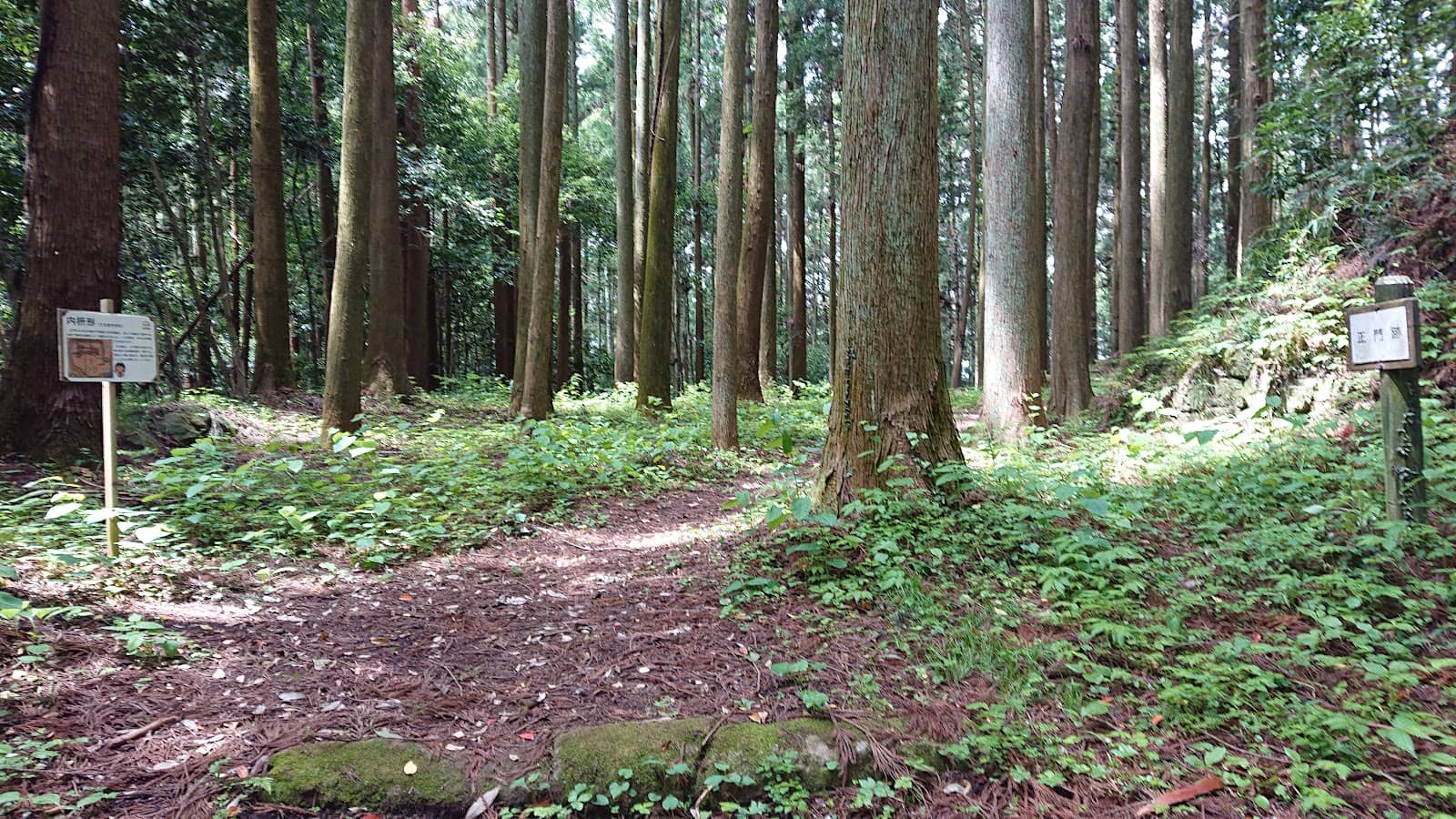
The castle grounds measure approximately 370 meters east to west and 510 meters north to south, and consist of five main areas known as the Gojo Sankaku, and include dry moats, vertical moats, moats, earthen ramparts, and other defensive facilities, with stone walls also constructed around the main enclosure.
Access to the castle is via the Nanamagariguchi entrance, on the east side of the castle grounds, where Kotobukiyama Shrine is located. Sannomaru, just before the entrance, was built by Hori Chikamasa, the lord of Karasuyama Domain, in the mid-Edo period. Afterward, the domain's administrative functions were transferred from Honmaru to the Sannomaru residence. We ascended the Shichimagakuguchi entrance, passed through the Kurumabashi and Tokiwa Kuruwa, viewed the stone walls of the Fukikanukimon Gate, passed through the main gate, and arrived at Honmaru (Ninomaru), then the Old Honmaru, Nakagusuku, and Kita Kuruwa...how vast is it?! We continued west to the Ono Kuruwa, then returned a little east and headed south through Nishi Kuruwa and Wakasa Kuruwa, and passed through an unnamed Kuruwa (bukuro) southwest of that. We then ascended Mount Chikushi via the Honmaru, and descended via the observation deck toward City Hall. It took about an hour and a half to leisurely explore the area. While there are many planted trees, the grass has been neatly cut, making the enclosure's shape clear. The dry moats, earthworks, and stone walls remain intact, and explanations are posted at key points. By exploring the area in order, the overall structure becomes clear. The dry moats around the Old Honmaru are truly enchanting. For now, this may be my favorite castle north of Kanto. I was so absorbed in the sights that I lost track of time.
After descending the mountain, I stopped off for lunch at Ishikawaya Handmade Soba, where the soba noodles and tempura were delicious and the portions were satisfying. It was a fond memory."
旅とグルメ人ken
"Visited on a weekday in late October 2024.
It's not one of the 100 famous castles, but it appeared in Nobunaga's Ambition, and I visited it because it's nationally designated.
I parked my car at the town hall and took the Bishamonten route, as directed by the tourism department, but the stairs were arduous. I had to climb up and down and cross one mountain.
I think the Nanamagari route from Sannomaru is better.
The areas around the Honmaru and Old Honmaru were nice.
The images I uploaded are in reverse order."
キャンロビ太陽
What People Like
What People Dislike
Frequently Asked Questions
🚇 🗺️ Getting There
The castle ruins are located on Mt. Hachiko. Parking is available for free near the Nanamagariguchi entrance or next to the Karasuyama Government Building. Visitors often combine a hike up the mountain with exploring the castle remains.
While specific public transport details can vary, it's generally recommended to drive or arrange local transport. The site is a mountain castle, making direct public access less common.
The Nanamagariguchi route from Sannomaru is often recommended for its scenic beauty, though the Bishamonten route is also an option, albeit more arduous with stairs.
You can drive to the base of the mountain where parking is available. The final ascent to the castle ruins requires walking and hiking.
Yes, free parking is available in designated areas near the entrances, making it convenient for visitors arriving by car.
🎫 🎫 Tickets & Entry
Admission to the Nasu Karasuyama Castle Ruins is generally free, as it is a historical site.
As an outdoor historical site, the castle ruins are typically accessible during daylight hours. There are no strict opening or closing times.
No, there is no entrance fee to explore the Nasu Karasuyama Castle Ruins.
Yes, volunteer guides are often available to provide insightful explanations of the castle's history and features.
The castle ruins are accessible year-round, though weather conditions may affect the hiking experience, especially in winter.
🎫 🧭 Onsite Experience
You can explore moats, earthworks, steep banks, stone walls, and remnants of gates. Informative boards detail the history of the Nasu clan and the castle's strategic importance.
A leisurely exploration can take about an hour and a half, but to see everything thoroughly, half a day is recommended.
Restroom facilities might be limited, especially higher up on the mountain. It's advisable to use facilities at the base or in town before ascending.
The site involves hiking and uneven terrain, so it's best suited for older children who can manage the walk. Parental supervision is essential.
The castle boasts dry moats, vertical moats, earthen ramparts, steep banks, and stone walls, showcasing its robust defensive design.
📸 📸 Photography
The panoramic views from the higher points of the ruins, the well-preserved dry moats, and the remaining stone walls offer excellent photographic opportunities.
Absolutely. The elevated position provides sweeping views of the surrounding landscape, especially beautiful during autumn.
Morning light can be soft and beautiful for capturing the details of the ruins, while late afternoon offers golden hour light for scenic vistas.
Drone usage regulations can vary. It's advisable to check local rules and obtain any necessary permissions before flying a drone over the historical site.
Generally, personal photography is allowed. However, it's always good practice to be respectful of the historical site and other visitors.



Social
from TikTok, Instagram & Reddit