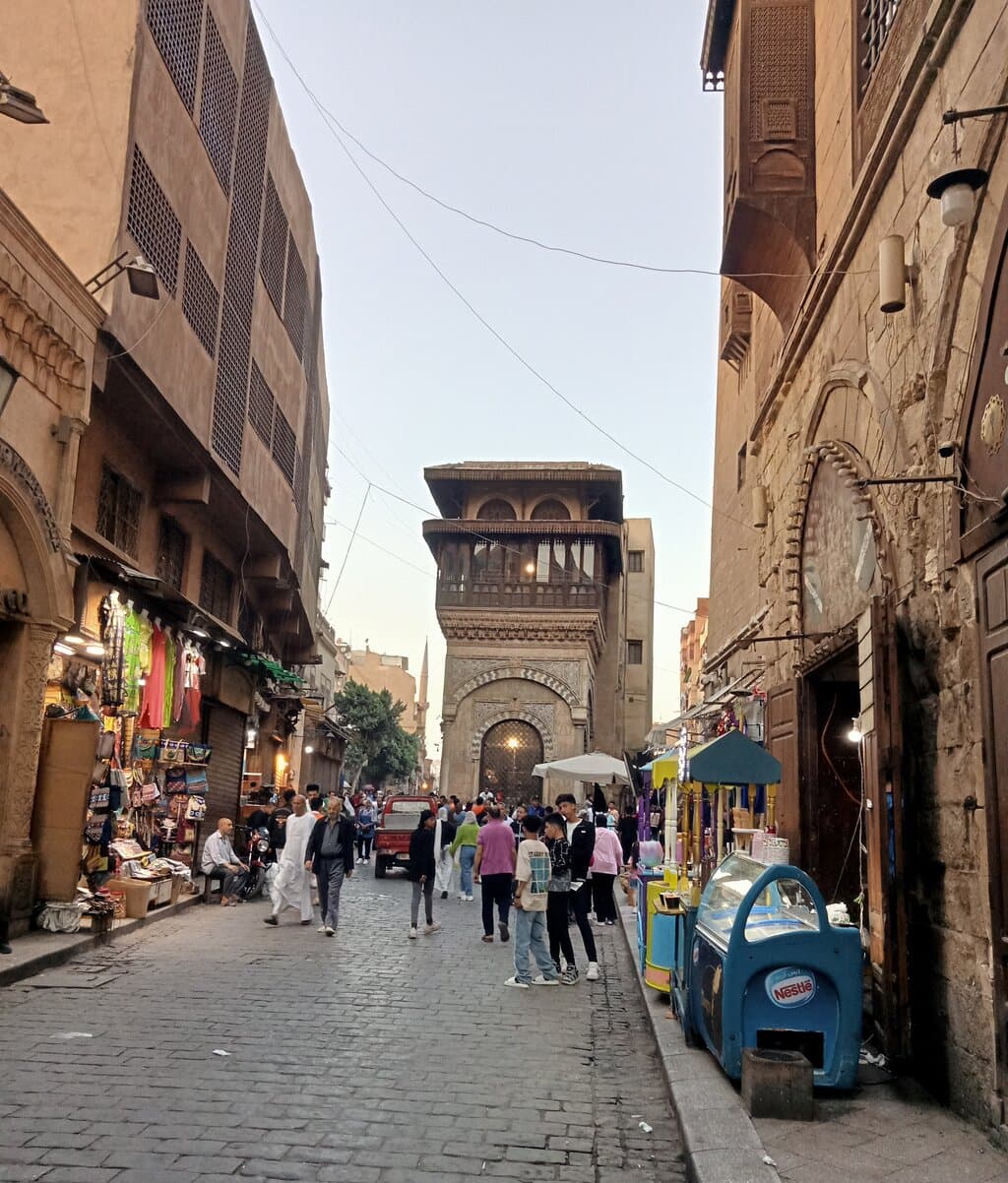
Sabil-Kuttab of Katkhuda Cairo
A stunning 18th-century Ottoman architectural treasure in Cairo, blending a public fountain with a Quranic school.

Highlights
Must-see attractions

Social
From TikTok & Reddit
Best Time
Fewer crowds, better light
Sabil-Kuttab of Katkhuda Cairo
Best Time
Fewer crowds, better light
Highlights
Must-see attractions
A stunning 18th-century Ottoman architectural treasure in Cairo, blending a public fountain with a Quranic school.
"A treasure of Ottoman architecture, beautifully illuminated at night."

🚶♀️ Stroll El Moez Street
The Sabil-Kuttab is on the main pedestrian axis of Islamic Cairo. Explore the street before or after your visit!
📸 Capture the Details
Don't just photograph the facade; zoom in on the intricate tilework and carvings inside.

Quick Facts
Hours
Rating
4.7 · 157 reviews
Type
Historical Landmark
Highlights
Discover the most iconic attractions and experiences

The Sabil (Public Fountain)
Ground floor
Admire the intricate stonework and elegant arches of this historic public water source, a testament to 18th-century craftsmanship.

The Kuttab (Quranic School)
Upper floor
Explore the space where children learned the Quran, featuring beautiful wooden ceilings and decorative motifs.

Ottoman & Mamluk Architectural Fusion
Exterior and interior
Marvel at the blend of Ottoman, Mamluk, and Islamic styles, showcasing a unique architectural heritage.
Plans like a pro.
Thinks like you
Planning Your Visit
Timing Your Visit to El Moez Street
Understanding Sabil-Kuttab Architecture
Best Times
Insider Tips
from TikTok, Instagram & Reddit
🚶♀️ Stroll El Moez Street
The Sabil-Kuttab is on the main pedestrian axis of Islamic Cairo. Explore the street before or after your visit!
📸 Capture the Details
Don't just photograph the facade; zoom in on the intricate tilework and carvings inside.
💡 Understand the History
Learn about its builder, Prince Abdel-Rahman Katkhuda, and the dual function of sabil and kuttab.
✨ Visit at Night
The building is beautifully illuminated after dark, offering a different, magical perspective.
Tips
from all over the internet
🚶♀️ Stroll El Moez Street
The Sabil-Kuttab is on the main pedestrian axis of Islamic Cairo. Explore the street before or after your visit!
📸 Capture the Details
Don't just photograph the facade; zoom in on the intricate tilework and carvings inside.
💡 Understand the History
Learn about its builder, Prince Abdel-Rahman Katkhuda, and the dual function of sabil and kuttab.
✨ Visit at Night
The building is beautifully illuminated after dark, offering a different, magical perspective.
🛍️ Unique Souvenirs
You might find artistic and unique souvenirs with good prices nearby.
What Travellers Say
Reviews Summary
Visitors praise the Sabil-Kuttab of Katkhuda as a beautiful architectural gem and a significant historical landmark in Cairo's Islamic quarter. Its unique blend of Ottoman and Mamluk styles, intricate details, and dual function as a fountain and school are frequently highlighted. While often taken for granted by passersby, those who explore inside find it a rewarding experience, especially when illuminated at night.
"Sabil-Kuttab of Abdel Rahman Katkhuda is a remarkable example of 18th-century Ottoman architecture in Cairo. This historic complex combines a public fountain (sabil) with a traditional elementary school (kuttab), reflecting both civic and educational functions of the period.
The structure features beautifully carved stonework, elegant arches, and intricate decorative details that highlight the craftsmanship of its era. Visitors can appreciate the harmonious design, the inscriptions, and the ornamental features that make it a visually striking landmark.
The site offers a peaceful and educational experience, showcasing the social and cultural heritage of Cairo. It is particularly appealing to history enthusiasts, architecture lovers, and anyone interested in the city’s Ottoman-era urban development."
Attia Adil
"Sapil Abd al-Rahman Katkhuda, which is surmounted by a place for the memorization of children, the Qur'an, known as the book, is located in a street intersection between Kasserine (Al Moez Street) and Timbuksha in the Al-Nahhasin area.
Prince Abd al-Rahman bin Hassan Gawish al-Qazdagli, "as a servant of Egypt, that is, the governor of Egypt." He was known as Abd al-Rahman, as a servant of the Mamluks during the era of Ali Bey al-Kabir, and he was appointed, after he was included in military positions until he became in charge of the army. In 1737 AD he was promoted to the rank of Gawish, then Bash Gawish, Ali Bek al-Kabir exiled him for thirteen years, then returned in 1776 AD, and he died shortly after, when he was seventy years old in 1776 CE and was buried in his mausoleum at the Al-Azhar Mosque.
Prince Abdel-Rahman Ktkhuda was one of the greatest sponsors of the architectural movement during the Ottoman era, and it was perhaps the most active in the history of Cairo as a whole, and many traces bearing his name and his works increased in building Al-Azhar, which is almost half of the roofed part on the qiblah side alone and its increase is higher than the land of the old mosque and has There is a mihrab, and he built the lighthouse of Al-Azhar, which is in the southeastern corner of Al-Azhar at the door of Upper Egypt, which is to the right of the interior, and to the left of the tomb of Abdul-Rahman as a line that the lighthouse overlooks. Also, it is suitable for many scenes, including the scene of Prince Othman, such as Takhadeh Al-Qazdogali.
This building is of special artistic importance, as it is an independent group that contains a path and writers in which many of the masterpieces of Islamic art are represented, especially in the Ottoman era. The building represents the style of the three-way avenues, and it takes the form in which the Mamluk and Ottoman styles blend together. The horizontal projection consists of a path topped by a book and below it a water tank that connects these levels with an inner staircase.
The Sabil room consists of a square area containing each of its southeastern, southwestern, and northwestern sides. Three entries are located by each entry held by a semi-circular knot. Each mesh entry contains a casting of copper casting and a rectangular marble basin window, while the northeastern side contains the entrance door to the Sabil room. From the darkness is adjacent to a wall-mounted cupboard above a window that overlooks the ladder leading to the book. The way walls are covered with impressive assemblies of Ottoman-style ceramic tiles and the most important characteristic of them is that they include a ceramic plate representing the noble Kaaba.
And the ceiling of the sublimation room is woody with colorful motifs consisting of stellar dishes and their parts, and is based on the stuccoed and mediterranean cornice that is not extended.
As for the book, the path is raised above the path, and it is reached from the ladder in front of the darkness, and it consists of a square area for each of its southeastern and exotic southern and northwestern ribs. The book has a wooden ceiling with colorful decorations.
Behind the three stone pavements, there is a corridor with a wooden ceiling with the same previous decorations. This corridor has three facades, each of which is a wooden arcade consisting of five semicircular arches centered on wooden columns. Below these three wooden facades is a veil of sculpted wood surmounted by a row of lacquers."
Mosaad Gedara
"If you are looking for an artistic unique souvenir with a good price, here is what you are looking for"
Doaa Ereiqat
What People Like
What People Dislike
Frequently Asked Questions
🚇 🗺️ Getting There
The Sabil-Kuttab of Katkhuda is located on El Moez Street, the main pedestrian axis of Islamic Cairo. It's easily accessible by taxi or ride-sharing services. Many visitors explore it as part of a larger walk through historic Cairo.
Yes, El Moez Street is a pedestrian-friendly street, perfect for walking and exploring the historic sites.
Walking is highly recommended to truly experience the atmosphere. Taxis or ride-sharing apps can get you to the general area.
Parking can be challenging in the dense historic areas. It's often best to get dropped off by a taxi or ride-share and explore on foot.
While metro stations are available in Cairo, they might require a further walk or a short taxi ride to reach El Moez Street directly.
🎫 🎫 Tickets & Entry
While the exterior is visible from El Moez Street, you can often visit the interior. Information on specific entry fees or if it's free can vary, but it's generally accessible.
Opening hours can be inconsistent in historic sites. It's best to visit during daylight hours, and it's particularly beautiful when illuminated at night.
Many sources suggest it's accessible without a formal ticket, but it's always good to check locally upon arrival.
Yes, many historic sites in Cairo are open during Ramadan, and some may even have special evening illuminations.
Yes, many visitors report being able to go inside and explore the sabil and kuttab sections.
🎫 🏛️ Onsite Experience
A Sabil-Kuttab is a historic building that combines a public fountain (sabil) for drinking water with an elementary Quranic school (kuttab).
The building is a beautiful blend of Ottoman, Mamluk, and Islamic architectural styles, showcasing intricate craftsmanship. 
Inside, you'll find impressive Ottoman-style ceramic tiles, wooden ceilings with colorful motifs, and detailed stonework.
Absolutely! It's considered a treasure of Ottoman architecture and offers a glimpse into Cairo's rich history and social structures.
You can see the sabil (fountain area) with its marble basins and the kuttab (schoolroom) with its decorative ceilings.
📸 📸 Photography
The facade is iconic, but don't miss capturing the details of the stonework, arches, and interior decorations.
Generally, photography is allowed, but always be respectful of the space and any ongoing activities.
Early morning or late afternoon offers softer light. At night, the building is beautifully illuminated, creating a dramatic effect.
Drone photography is typically restricted in historic and densely populated areas of Cairo. It's best to avoid it.
A wide-angle lens is useful for the facade, while a prime lens can capture intricate details inside.



Social
from TikTok, Instagram & Reddit