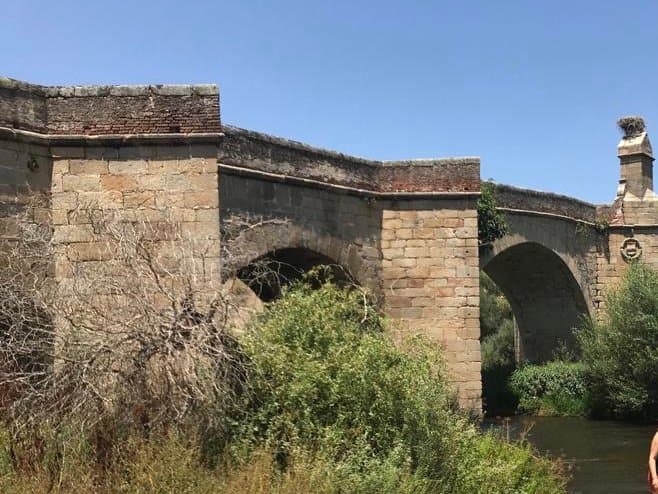
Alcántara Roman Bridge
A breathtaking Roman bridge, a testament to ancient engineering, gracefully spanning the Tagus River with majestic arches.

Highlights
Must-see attractions

Social
From TikTok & Reddit
Best Time
Golden hour light, fewer crowds
Alcántara Roman Bridge
Best Time
Golden hour light, fewer crowds
Highlights
Must-see attractions
A breathtaking Roman bridge, a testament to ancient engineering, gracefully spanning the Tagus River with majestic arches.
"One of the most impressive Roman monuments I have seen!"

📸 Capture the Golden Hour
Visit during sunrise or sunset for breathtaking photos of the bridge bathed in warm light.
🚶 Walk Across History
Stroll across the bridge to truly appreciate its scale and the stunning views of the Tagus River.

Quick Facts
Hours
Rating
4.8 · 2,882 reviews
Type
Historical Landmark
Highlights
Discover the most iconic attractions and experiences
The Grand Arches
Tagus River
Six majestic semi-circular arches, a testament to Roman architectural prowess, gracefully spanning the Tagus River.

Trajan's Triumphal Arch
Center of the bridge
A monumental arch honoring Emperor Trajan, a powerful symbol of imperial might and Roman engineering.

Temple of Caius Julius Lacer
Bridge entrance
A unique small temple dedicated to the bridge's architect, offering a personal touch to this ancient structure.
Plans like a pro.
Thinks like you
Planning Your Visit
Timing is Key for the Best Views
Respect the History and Surroundings
Best Times
Insider Tips
from TikTok, Instagram & Reddit
📸 Capture the Golden Hour
Visit during sunrise or sunset for breathtaking photos of the bridge bathed in warm light.

🚶 Walk Across History
Stroll across the bridge to truly appreciate its scale and the stunning views of the Tagus River.
🏛️ Explore the Town
Don't miss the historical center of Alcántara uphill from the bridge for more architectural gems.
🗺️ Geocaching Adventure
For a unique experience, try geocaching near the bridge!
Tips
from all over the internet
📸 Capture the Golden Hour
Visit during sunrise or sunset for breathtaking photos of the bridge bathed in warm light.
🚶 Walk Across History
Stroll across the bridge to truly appreciate its scale and the stunning views of the Tagus River.
🏛️ Explore the Town
Don't miss the historical center of Alcántara uphill from the bridge for more architectural gems.
🗺️ Geocaching Adventure
For a unique experience, try geocaching near the bridge!
What Travellers Say
Reviews Summary
Visitors consistently praise the Alcántara Roman Bridge as a stunning feat of Roman engineering set in a beautiful natural landscape. Many are impressed by its scale and preservation, calling it one of the most impressive Roman monuments they've seen. While the bridge itself is the main draw, the surrounding town and river views add to the overall positive experience.
"A beautiful, stunning engineering feat, in a beautiful natural setting.
Standing as a monumental testament to the genius of Roman engineering, the Alcántara Bridge majestically crosses the Tagus River in Cáceres, Spain. Constructed in just two years between 104 and 106 AD, during the reign of the Hispanic Emperor Trajan, it remains one of the most remarkable surviving pieces of Roman civil architecture.
The bridge's name, derived from the Arabic al-Qantarah ("the bridge"), reflects the awe it has inspired for centuries. Its design, attributed to the architect Caius Julius Lacer, is a marvel of precision and scale. Built from mortarless granite blocks, it stretches 194 meters long and soars to a breathtaking height of 71 meters from the riverbed to its deck.
Its most notable features include:
* Six Soaring Arches: The bridge is supported by six grand, semi-circular arches that vary in size, with the two central arches being the largest, showcasing the Romans' mastery of this architectural form.
* Triumphal Arch: At its center stands a 14-meter-high triumphal arch honoring Emperor Trajan, a common feature to broadcast imperial power and commemorate the public work.
* A Unique Temple and Inscription: Uniquely for a Roman bridge, one of its entrances features a small temple. Inside, a poignant inscription dedicates the bridge to Trajan and immortalizes its creator, Caius Julius Lacer, who expressed his hope that the bridge would "last for eternity in the ages of the world."
Despite Lacer's ambition, the bridge's strategic importance made it a target in later conflicts. The westernmost arch was destroyed during the Reconquista in 1214 and rebuilt in the 16th century. Later, the second arch on the opposite side was blown up during the Peninsular War in 1809 to halt French troops and was not fully restored until 1860.
One of the most impressive Roman monuments I have seen!
Even my fiancee, who has little interest in history, was impressed and thoroughly enjoyed our visit."
Orion Bukantis
"If you like to touch history and an 1800 year old, Roman Bridge it is worth the trip, about 75 minutes from Caceres going west towards Portugal."
R and B
"Puente Romano de Alcántara – A Timeless Marvel of Roman Engineering
The Puente Romano de Alcántara is one of the most impressive Roman bridges still standing today. Located in the town of Alcántara, Spain, this nearly 2,000-year-old structure is a testament to the ingenuity and durability of Roman engineering.
History & Architecture
Built between 104 and 106 AD during the reign of Emperor Trajan, the bridge was designed to span the Tagus River, connecting important trade routes in the Iberian Peninsula. The architect, Caius Julius Lacer, left an inscription claiming that the bridge would last forever—and so far, he has been right.
The bridge features six grand arches, supported by massive stone piers, reaching a height of nearly 57 meters (187 feet) and stretching 194 meters (636 feet) in length. At its center, a triumphal arch stands in honor of Trajan, adding to its monumental presence. The materials used—large, precisely cut granite blocks—have withstood wars, floods, and centuries of wear.
Cultural & Historical Significance
The bridge has witnessed many historical events, from Moorish invasions to Napoleonic battles. It suffered damage over the centuries, especially during conflicts, but was repeatedly restored, maintaining its original grandeur. Today, it is a symbol of Spain’s Roman heritage and an essential site for history and architecture enthusiasts.
Visiting the Bridge
Puente Romano de Alcántara is not just an ancient relic—it is still open to pedestrian traffic, allowing visitors to walk across and admire the breathtaking views of the Tagus River. The surrounding town of Alcántara."
Tracy ANDERSON
What People Like
What People Dislike
Frequently Asked Questions
🚇 🗺️ Getting There
The Alcántara Roman Bridge is located in the town of Alcántara, Cáceres, Spain. It's approximately a 75-minute drive west from Cáceres towards Portugal. Many visitors drive, as it's a scenic route through Extremadura. Public transport options might be limited, so checking local bus schedules in advance is recommended.
Yes, there are usually parking areas available in the town of Alcántara, a short walk from the bridge. It's advisable to look for designated parking spots to avoid any issues.
Absolutely! The Alcántara Roman Bridge makes for an excellent day trip from Cáceres, taking about 75 minutes each way by car. You can combine it with exploring the town itself.
🎫 🎫 Tickets & Entry
No, the Alcántara Roman Bridge is an open-air historical monument and is generally free to visit and walk across.
As an outdoor historical site, the bridge is accessible at all times. However, visiting during daylight hours is recommended for the best experience and safety.
There is no entrance fee to access and walk across the Alcántara Roman Bridge. It's a public monument.
🎫 🧭 Onsite Experience
You can admire the six grand arches, the triumphal arch dedicated to Emperor Trajan, and the unique temple of Caius Julius Lacer. The views of the Tagus River are also spectacular.
Yes, the bridge is open to pedestrian traffic, allowing you to walk its length and experience its grandeur up close.
Definitely! The bridge offers incredible photographic opportunities, especially during the golden hours of sunrise and sunset.
Built between 104-106 AD, it's a remarkable example of Roman civil engineering, designed to last for eternity. It has witnessed centuries of history and conflict.
While official guided tours might not always be readily available, you can find plenty of historical information online and through local tourist offices. The bridge's history is fascinating to explore.
🍽️ 🍽️ Food & Dining
Yes, the town of Alcántara has several restaurants and cafes where you can enjoy local Extremaduran cuisine after your visit to the bridge.
You can expect traditional Spanish and regional Extremaduran dishes, often featuring local produce, meats, and cheeses. Look for places serving Iberian ham and stews.
📸 📸 Photography
The 'golden hours' around sunrise and sunset provide the most dramatic and beautiful lighting for capturing the bridge.
Experiment with shots from the riverbanks to capture the full span of the arches, and get closer to highlight the intricate stonework and inscriptions.
Drone regulations can vary, and it's always best to check local rules and obtain any necessary permits before flying a drone over historical sites or protected areas.






Social
from TikTok, Instagram & Reddit